What Is an EPC Certificate and Why Do I Need One?

If you've put your house on the market, started looking for a new rental, or simply spotted a mysterious A-to-G coloured chart on a property listing and wondered what it actually means, you've come across an Energy Performance Certificate — or EPC for short. It's one of those documents that almost everyone in the UK property market has heard of, but surprisingly few people can explain properly. So let's clear it up.
What Is an EPC Certificate?
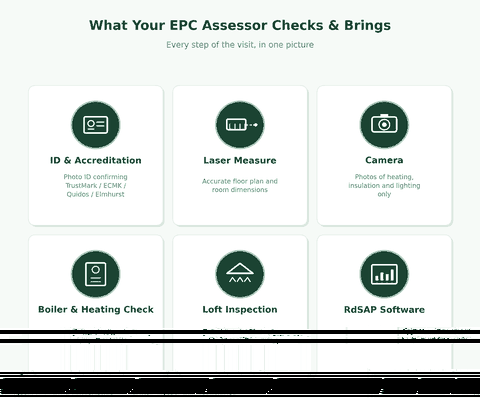
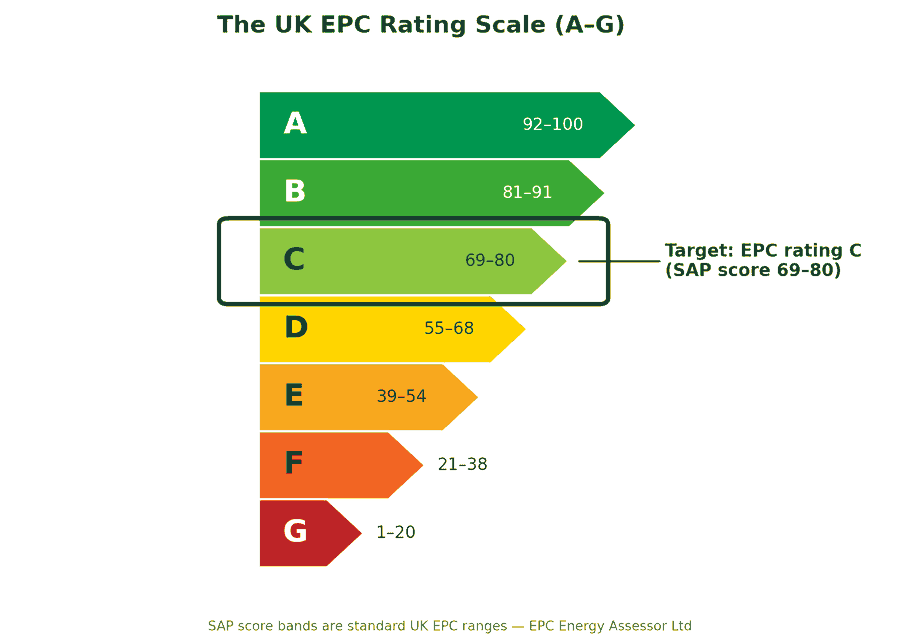
An EPC is an official document that rates how energy efficient a building is, using a scale from A (most efficient) down to G (least efficient). It's produced after a qualified, accredited domestic energy assessor visits the property, records its construction, heating system, insulation, glazing, and other relevant features, and runs that information through government-approved software (RdSAP) to generate a rating.
The certificate itself gives you two ratings: your current energy efficiency score and a "potential" score showing what you could achieve with recommended improvements. It also estimates your likely annual energy costs and lists specific, prioritised recommendations — things like loft insulation top-ups, cavity wall insulation, or upgraded heating controls — along with a rough sense of the cost and benefit of each one.
Crucially, an EPC can only be produced by someone who is properly accredited. At EPC Energy Assessor Ltd, our assessors are licensed through ECMK, Quidos, and Elmhurst — three of the main accreditation schemes recognised across England and Wales — and we're TrustMark-registered and fully insured, so you know the certificate you receive is both legally valid and produced to a proper professional standard.
Why Do You Legally Need One?
This is where a lot of confusion comes from, because the honest answer is: it depends on what you're doing with the property, but in most common situations, yes, you need one, and it's a legal requirement rather than a nice-to-have.
If you're selling a property, an EPC needs to be commissioned before the property is marketed, and a valid certificate must be made available to prospective buyers. If you're a landlord letting out a residential property, you're legally required to have a valid EPC in place before a new tenancy begins, and under the Minimum Energy Efficiency Standards (MEES) regulations, most rented properties currently need to meet at least an E rating (readers should double-check the very latest MEES thresholds and any upcoming changes on gov.uk, since minimum standards for rental properties have been under review and can shift). If you're having a new home built, an EPC is required as part of building regulations sign-off.
Even outside these legal triggers, having an up-to-date EPC is genuinely useful. It gives you a clear, independent snapshot of how your home performs, flags cheap wins you might not have thought about, and — if you're selling — reassures buyers that there are no nasty energy-cost surprises waiting for them.
What Does the EPC Actually Show?
Beyond the headline A–G rating, a good EPC report is a genuinely useful document. It includes your property's estimated energy costs for heating, hot water and lighting, the environmental impact (CO2 emissions) rating alongside the efficiency rating, a breakdown of key features like wall type, roof insulation, windows and main heating system, and a set of tailored recommendations ranked by typical cost and impact, so you can see at a glance whether next winter's biggest opportunity is loft insulation, a smart thermostat, or something bigger.
It's worth saying clearly: the EPC is a standardised assessment based on the physical characteristics of the building, not on how you personally use energy day to day. It won't reflect the fact that you like the heating on 24/7, or that you barely turn it on — that's a separate conversation entirely (and one we get asked about a lot, because it explains why a home can have a decent rating but still feel chilly, or vice versa).
When Do You Need to Get One?
In practice, most people book an EPC assessment at one of a handful of moments: when instructing an estate agent to market a property for sale, before advertising a rental property to new tenants, when an existing EPC is about to expire (they're valid for ten years), or ahead of a remortgage or energy-efficiency grant application where lenders or scheme administrators ask for evidence of current performance.
If you're a landlord managing several properties, or you run an HMO or social housing stock, timing gets a bit more involved, since each unit may need its own certificate and renewal dates can end up scattered across the year. This is one of the areas we specialise in at EPC Energy Assessor Ltd — HMO and social housing assessments have their own quirks (shared facilities, multiple kitchens, individually let rooms) and it genuinely helps to work with an assessor who does this routinely rather than occasionally.
How EPC Energy Assessor Ltd Makes It Simple
We cover Staines-upon-Thames, Windsor, Slough, Egham, Datchet, Old Windsor, Bracknell, Wraysbury, and the wider area within roughly 15–20 miles of Staines/TW19, across Surrey, Berkshire and Middlesex. A few things set how we work apart from the bigger comparison-site operators.
There's no faceless call centre or agency middleman between you and your assessor — when you book, you're booking directly with the person who'll actually turn up and carry out the assessment, and you can speak to us directly about your property before or after the visit. Once the assessment is done, we lodge your certificate on the official register within 24 hours, so you're not left waiting around when you're on a tight completion date or a tenancy deadline. And because we handle a genuine mix of property types day to day — including HMOs and social housing, which trip up assessors who mostly do straightforward owner-occupied homes — we're comfortable with the more complicated cases too.
Pricing is straightforward and scales with the size of the property: a studio or one-bedroom home is £95 (around 45 minutes on site), rising to £120 for a two-bed, £135 for a three-bed, £150 for a four-bed, £170 for a five-bed and £200 for a six-bed (most of these around an hour on site), with bulk discounts available if you're getting several properties assessed at once — handy for landlords and letting agents managing a portfolio.
If you need an EPC certificate — whether you're selling, letting, or just want an up-to-date picture of your home's efficiency — give us a call on 07850 408160, email info@epcenergyassessor.co.uk, or book directly online. We'll get you booked in quickly, visit at a time that suits you, and have your certificate lodged within 24 hours.

Comments