
How to Get an EPC Rating of C: The Complete Guide

Updated: Sep 6
If you've searched "how to get an EPC rating of C", you're almost certainly one of two people: a homeowner who's just seen their current rating and wants to do better, or a landlord who's heard that a C rating is becoming the new normal for rental property and wants to get ahead of it. Either way, the good news is that moving a property from a D, E or even an F up to a C is rarely about one dramatic renovation. It's usually a handful of well-chosen improvements, tackled in the right order, that add up to a meaningfully better rating, lower bills and — for landlords in particular — a property that stays lettable as the rules keep tightening.
This guide walks through what a C rating actually means, why landlords especially are being pushed toward it, and exactly which improvements are most likely to get you there, roughly what they cost, and how to work out which ones your own property actually needs.
What Does an EPC Rating of C Actually Mean?
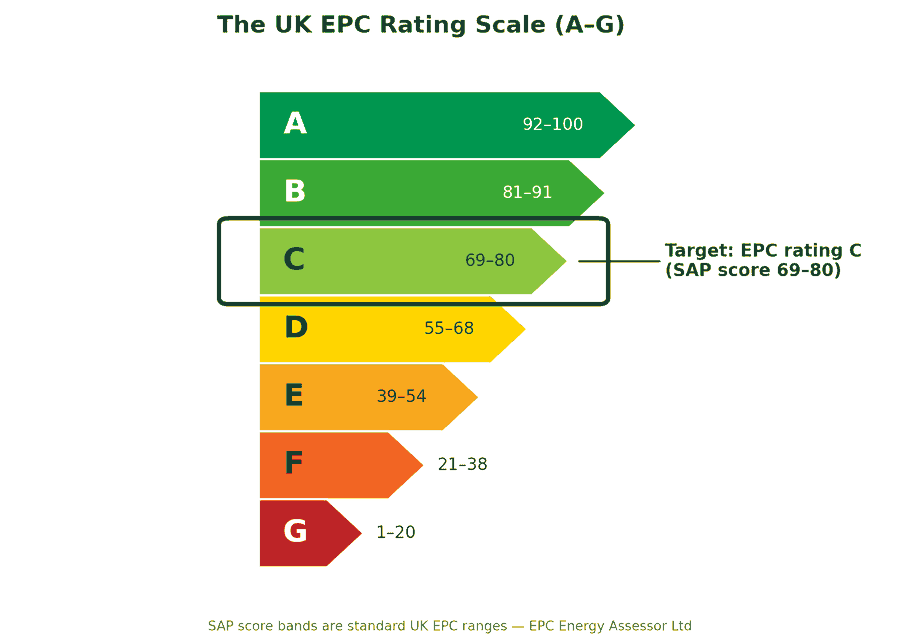
Every Energy Performance Certificate scores a property on a SAP scale of 1 to 100 and then translates that number into a letter band from A (best) to G (worst). A rating of C corresponds to a SAP score of roughly 69 to 80, sitting just above the UK average, which tends to cluster around D. In plain terms, is an EPC rating of C good? Yes — it's generally considered a genuinely efficient home without requiring the kind of wall-to-wall renovation that an A or B rating often demands, which is exactly why C has become the practical target for both government policy and most homeowners.
The image below shows where C sits relative to the other bands, and it's worth keeping this scale in mind as you read the rest of this guide, since most of the improvements we cover are really about nudging your SAP score up into that 69–80 range.
Why Landlords Will Need an EPC Rating of C
For homeowners, reaching a C rating is mostly about comfort and running costs — a more efficient home costs less to heat and holds its temperature better. For landlords, though, there's a regulatory dimension too. The current Minimum Energy Efficiency Standards (MEES) require most privately rented properties in England and Wales to hold at least an E rating before they can be let, and a property with an F or G rating is at real risk of being unlettable without an approved exemption.
Government policy has, for some time, pointed toward raising that minimum considerably further, up to a C rating for the private rented sector, with social housing providers facing a similar C-rating target of their own. Exact deadlines for the private rented sector have shifted before and remain subject to consultation and confirmation, so rather than quote a specific year here, we'd strongly encourage every landlord to check the current position on gov.uk before making decisions based on a deadline. What's consistent across every version of this policy, though, is the direction of travel: C is where the private rented sector is heading, and landlords who get there early avoid a last-minute scramble.
There are practical reasons to move now even before any deadline bites. A property with an EPC rating of D or E is simply less attractive to tenants who are increasingly conscious of energy bills, and mortgage lenders are steadily introducing more favourable rates for well-rated buy-to-let properties. If you manage a whole portfolio, we work with quite a few landlords doing exactly this — improving properties in batches as tenancies turn over, rather than waiting for every property to need attention at once. Our landlord services cover exactly this kind of ongoing, multi-property support, including HMO and social housing assessments where the certification requirements are a little more involved.
How Is Your EPC Rating Calculated?
Before diving into individual improvements, it helps to understand what the assessor is actually measuring. Your SAP score is built from a combination of factors: the thermal performance of your walls, roof and floor; the age and efficiency of your heating system; how well your hot water is generated and stored; the type of glazing throughout the property; and the lighting fitted in each room. Solar panels, thermal store cylinders and a handful of other renewable or low-carbon features can also add to the score. No single factor decides the outcome on its own — it's the combination that lands you in a particular band, which is exactly why two seemingly similar assessors can occasionally reach slightly different conclusions on borderline properties, simply based on which improvements a property does or doesn't have.
Step-by-Step: How to Get Your Property to a C Rating
The improvements below are listed roughly in order of typical cost-effectiveness — the ones that tend to move the SAP score the most per pound spent come first, though the right order for your specific property depends on what you're missing.

Insulation comes first. Does loft insulation improve EPC rating? Almost always, and it's usually the cheapest win available — topping up loft insulation to around 270mm is inexpensive, non-disruptive, and can move a property up a full band on its own if the existing insulation is thin or patchy. Does cavity wall insulation improve EPC rating? Yes, and often dramatically, since uninsulated cavity walls are one of the biggest sources of heat loss in a typical UK home; if your property was built with a cavity and it's never been filled, this is usually the next thing to check. Solid-wall properties are a different story, since internal or external wall insulation is a much bigger and more expensive job, so it tends to come later in the priority list unless you're already planning other structural work.
Heating and hot water make a big difference too. Does a combi boiler improve EPC rating, or does a heat pump improve EPC rating more? Both can help significantly if you're currently running an old, inefficient boiler — a modern condensing combi boiler is a substantial upgrade on its own, while an air source heat pump goes further still, though it's a bigger investment and works best alongside good insulation, since heat pumps perform less efficiently in a poorly insulated home. Smart heating controls (thermostatic radiator valves, a programmer that lets you heat rooms independently) add a smaller but genuine boost, and they're inexpensive relative to almost everything else on this list.
Glazing and lighting round out the fabric of the property. Single glazing is a significant drag on an EPC score, so replacing it with double glazing (or upgrading older double glazing to modern units) helps meaningfully, particularly in older housing stock common across our patch of Surrey, Berkshire and Middlesex. Swapping every bulb in the property for LEDs is one of the cheapest changes on this entire list and genuinely does count toward your score, so it's worth doing even if it feels like a minor detail compared to insulation or heating.
Renewables can tip a borderline property over the line. Do solar panels improve EPC rating? Yes — a solar PV system reduces the property's assumed reliance on grid electricity and can be the deciding factor for a property that's sitting just below the C threshold after everything else has been addressed. It's rarely the first improvement we'd recommend purely on cost, but for a property that's close to C already, it can be the most efficient way to close the final gap.
One improvement worth ruling out early: does a smart meter improve EPC rating? No — a smart meter helps you monitor and manage your energy use, which is genuinely useful, but it isn't one of the factors the SAP calculation actually scores, so don't expect it to move your rating on its own.
How Much Does It Cost to Improve Your EPC Rating?
Costs vary enormously by property size, construction type and how much work is actually needed, so treat the following as typical UK ranges rather than a quote, and always get quotes from qualified installers before committing. Loft top-up insulation tends to be one of the cheapest jobs, often a few hundred pounds. Cavity wall insulation is usually similarly modest for an average semi-detached or terraced property. Double glazing for a whole house is a considerably bigger job, often running into several thousand pounds depending on the number of windows. A new condensing boiler typically costs a couple of thousand pounds installed, while an air source heat pump is a larger investment, often into five figures before any grant support. Solar panel systems vary widely with system size but are also typically a four-figure-plus investment. Government grant schemes for insulation, heating upgrades and renewables do exist and change fairly regularly, so it's always worth checking gov.uk for whatever scheme is currently running before you budget, since a grant can meaningfully change the economics of a bigger job like a heat pump.
How Do You Know Which Improvements You Actually Need?
This is the part people often skip: your own EPC certificate already tells you. Every EPC includes a recommendations section listing the specific improvements suggested for that individual property, roughly in order of cost-effectiveness, along with the estimated impact each one would have on your rating. Rather than guessing which of the improvements above apply to your home, the fastest and cheapest starting point is simply to get a current, accurate assessment and read the recommendations it comes with.
That's exactly the service we provide. As a TrustMark-registered assessor licensed through ECMK, Quidos and Elmhurst, we carry out full domestic EPC assessments across Surrey, Berkshire and Middlesex, with certificates lodged within 24 hours so you're not left waiting to plan your next step. We book directly with no forms or agency middlemen in the way, and if you're a landlord managing several properties, we offer bulk discounts and have specific experience with HMO and social housing assessments through our dedicated landlord services.
EPC Assessments Across Surrey, Berkshire and Middlesex
We carry out EPC assessments throughout Staines-upon-Thames, Windsor, Slough, Egham, Datchet, Old Windsor, Bracknell and Wraysbury, along with the wider area within around 15–20 miles of Staines and the TW19 postcode. If you're not sure whether your town is covered, get in touch and we'll confirm straightaway.
Whether you need a fresh assessment to find out exactly which improvements would move your property up to a C, or you've already made the changes and want an updated certificate to show for it, you can book your EPC assessment online in a couple of minutes, or call us directly on 07850 408160 to talk it through first.

Comments